


Which Games Have the Most to Lose When GTA VI Launches?

GTA VI launches November 19, and you don’t need our research to know it’s going to be a major moment. Anticipation has moved well beyond gaming circles, showing up everywhere from industry headlines and online conversation to SNL and South Park. We see the scale of it in our own data too, with 69% of PC and console gamers ages 18 and older in Open World’s Q3 2026 Quarterly Games Survey saying they would “definitely” or “probably” play it once it releases.
What’s much harder to know is what a launch of this scale will mean for individual games. How many players will shift some of their attention to GTA VI? How much time will they give up elsewhere? And should teams stay the course, pull back around launch, or plan for a bigger re-engagement push afterward?
Those are the questions our R/DA team (that’s Research & Data Analytics for those of you who are new here) wanted to help answer. But before GTA VI is actually in market, there’s no single magic measure that can tell us exactly what players will do. From experience, we know that stated intent often overstates actual behavior, while historical gameplay can’t fully account for a launch this unprecedented. So we looked at both across a variety of games, combining players’ past relationship with GTA with their future intent to play GTA VI to get a better sense of which audiences may be relatively more or less exposed.
How We Measured GTA VI Launch Risk
We looked at 27 major PC and console titles.
For historical engagement, we used PlayDX, our behavioral gameplay dataset of 3.7 million PC and console gamers, excluding Switch. We measured the share of each game’s current players who had played a GTA title in the previous four years.
For future intent, we used Open World’s August–September 2026 Quarterly Games Survey to measure the share of each game’s current players who said they would ‘definitely’ or ‘probably’ play GTA VI and had access to a launch-eligible console.
We then placed each title above or below the 27-title average on both measures. That gave us four risk tiers:
- Highest direct risk: these audiences already have a strong relationship with GTA and are highly likely to show up for GTA VI at launch, making them the most exposed to near-term shifts in player time (i.e., both GTA history and launch intent are above average)
- Intent-led emerging risk: these audiences haven’t historically overlapped with GTA as much, but their interest in GTA VI is relatively high, suggesting the launch may reach further into these audiences than past behavior would suggest (i.e., launch intent is above average, while GTA history is below average)
- Exposure-led contained risk: these audiences have plenty of history with GTA, but fewer players are currently positioned to play GTA VI at launch, indicating clear underlying affinity but more limited immediate launch risk (i.e., GTA history is above average, while launch intent is below average).
- Lower near-term risk: these audiences have less historical overlap with GTA and lower launch intent relative to the other games we analyzed, so while they may still feel some impact, they appear less exposed than other audiences during the launch window (i.e., both GTA history and launch intent are below average)
What We Learned
Sports Games and Console-Heavy Competitive Shooters Face the Most GTA VI Risk
NBA 2K, EA Sports FC and Skate sit toward the top of the risk map, alongside competitive titles like Call of Duty, Battlefield, Rainbow Six Siege, and Fortnite.
These audiences tend to skew male and have more console players. Both characteristics are associated with stronger GTA VI launch interest in our data. Many of them are also accustomed to showing up for gaming’s biggest releases each year, whether that’s a new Call of Duty or the annual EA Sports and NBA 2K cycle, so shifting some of their time toward another major launch is already a familiar behavior.
Counter-Strike 2 tells a slightly different story. Its players have plenty of historical GTA overlap, but lower launch-addressable intent due in large part to its more PC-skewing audience and the fact that fewer players have access to a launch-eligible console. That could change if GTA VI comes to PC in early 2027, as has recently been reported. By then, reviews, word of mouth and several months of actual player behavior could reshape interest.

Higher-Risk Audiences Share an Appetite for Speed, Stakes, and Action
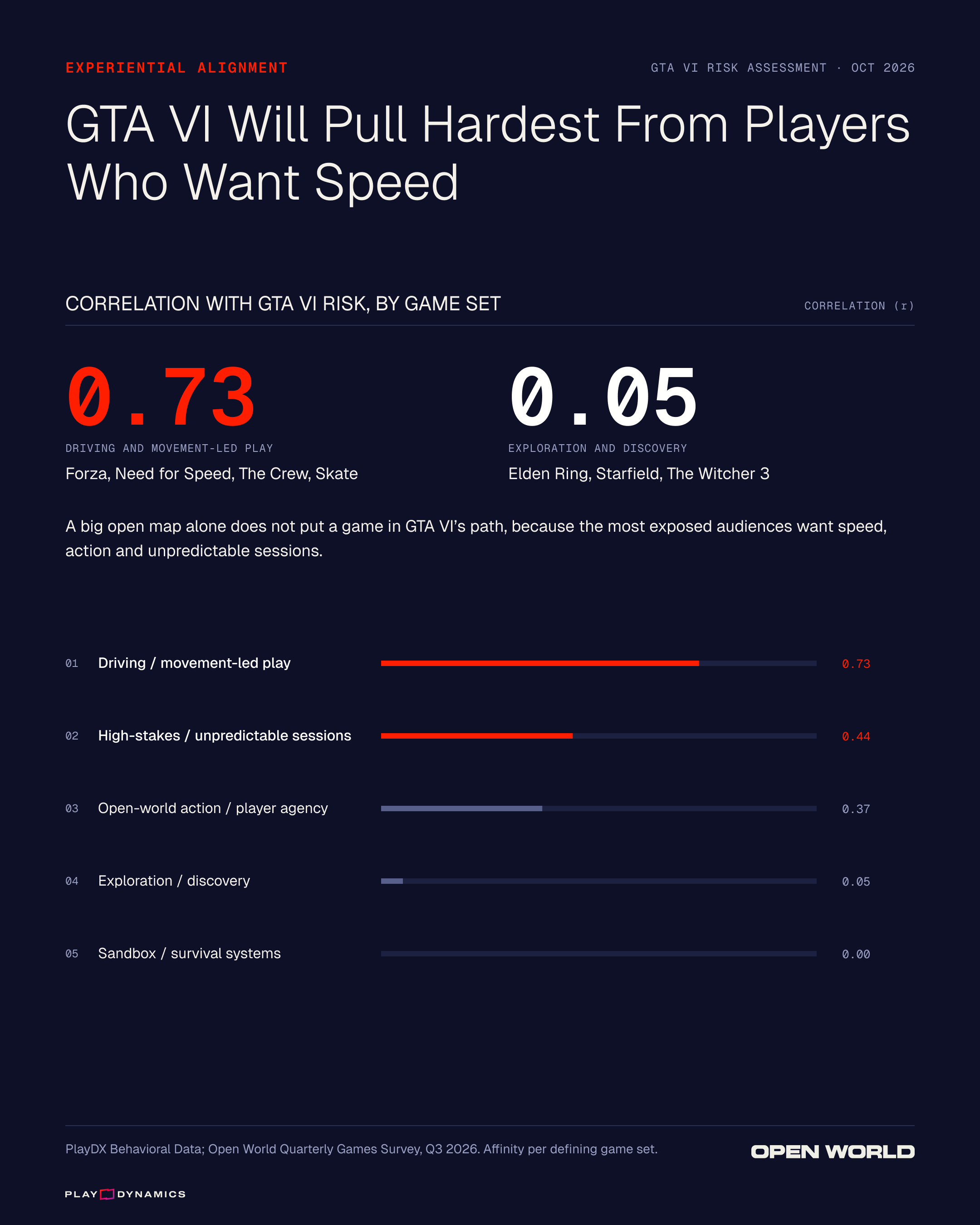
Genre only tells part of the story. We also profiled audiences based on the types of gameplay experiences they engage with to understand which elements are most associated with GTA VI risk. The strongest relationships show up around driving and movement-led play, high-stakes and unpredictable sessions, and open-world action and player agency. Across all three, the common thread is a style of play that keeps players moving, reacting, and making consequential choices, which maps closely to what GTA itself delivers.
What’s also notable is what doesn’t show the same relationship. Exploration and sandbox survival have little to no connection with GTA VI risk, suggesting that the appeal isn’t simply about having a large world to explore or the freedom to create your own experience. What seems to matter more is the action and surprise moments inside that world.
Even Highly Dedicated Audiences Are Exposed During the GTA VI Launch Window
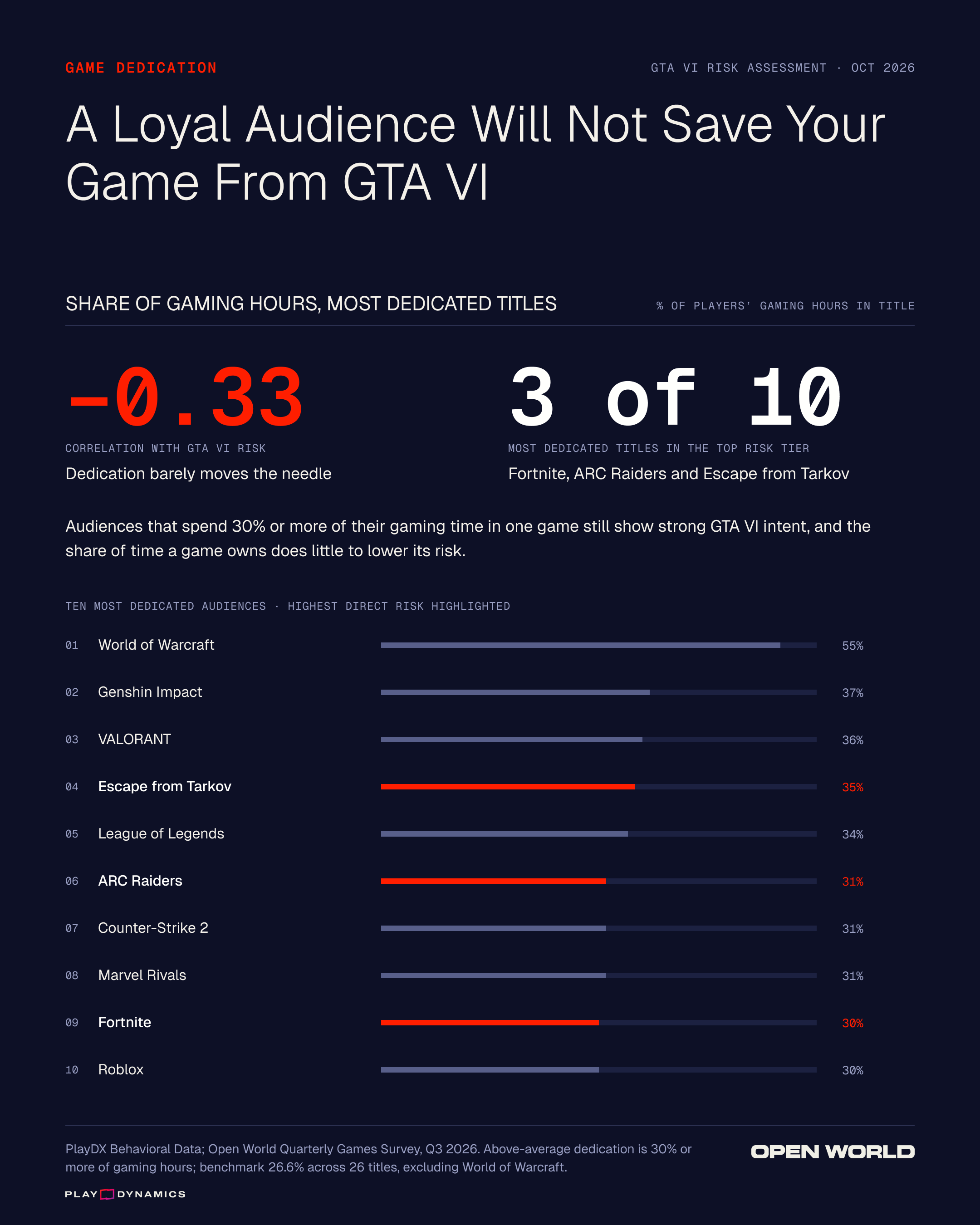
Players who spend most of their gaming time in one title aren’t necessarily sitting GTA VI out. Dedication has only a modest negative relationship with launch risk (r = -0.33), and audiences like Fortnite, ARC Raiders and Escape from Tarkov still show meaningful GTA VI interest despite already giving 30% or more of their gaming time to those games.
That doesn’t mean players will stop playing their favorite games, or that any shift will last. But even loyal players have a limit on how much time they can play. If GTA VI takes up a few hours, those hours have to come from somewhere. Some may come from sleep or other parts of life, but some are likely to come from the games they already play. Even a temporary reduction in hours across part of an audience can have a real impact during the launch window.
World of Warcraft will be especially interesting to watch. Its players spend 55% of their gaming time in WoW, far more than any other audience we analyzed, while still showing relatively high GTA VI intent but lower historical overlap. With World of Warcraft: Forever launching just weeks beforehand, those players may have a major new reason to stay in the WoW universe, which could limit how much time, if any at all, they shift to GTA VI or simply delay when they check it out.
How to Think About the GTA VI Launch Window
The framework isn’t meant to tell teams to go dark in November. In fact, for some teams it may suggest the opposite. The value is in helping you think more deliberately about where to stay the course, where to adjust, and where you may want to move your biggest moments based on how exposed your audience is.
At the highest end of the risk spectrum, timing probably matters most. Players who are buying GTA VI and spending significant time with it will have less time, attention, and potentially money to give somewhere else. You should still support your game and the players who remain active, but if timing is flexible, consider moving your biggest DLC, creator campaign, new skins, or major paid push away from launch week. Those moments could have more impact a few weeks later as players start settling back into more typical gaming habits.
For games that have audiences with high GTA VI intent but less history with the franchise, there’s more uncertainty. Some players will check it out, while others may not change their habits much at all. The goal here is balance. Continue giving the players who stay something worth engaging with, while being thoughtful about putting your biggest or most expensive moments directly against launch until you have a better read on how much of that stated interest turns into actual behavior.
And if your audience sits toward the lower end of the risk spectrum, business as usual may be the better strategy. Not everyone wants to play GTA VI, and those players will still be looking for new content, reasons to engage, and games that continue to show up for them. If more exposed competitors pull back during the launch window, staying active could even create an opportunity to capture more attention rather than less.
Keep Tabs on What Players Actually Do
Everything we’ve outlined here is our best view of relative risk before GTA VI is actually in players’ hands. Once it launches, we can move beyond intent and start watching what people actually do. How many players adopt it? How much time shifts away from other games? Who reduces their play, who takes a break, and how quickly do they come back?
Those behaviors should ultimately guide what comes next, including when to ramp activity back up and which players may need the strongest reason to return. If you want to understand where your own audience sits ahead of launch, or track how their behavior changes once GTA VI is out, Open World’s R/DA team is here to help.
Download the report here
If you want to size GTA 6 risk inside your own player base, Open World's R/DA team can help, talk to us.
Methodology: Open World Quarterly Games Survey, Q3 2026, PC and console gamers 18+, and the PlayDX behavioral database. Risk tiers place each of 27 titles against the 27-title average on GTA overlap during the previous four years and launch-addressable GTA VI intent.
Latest Insights
All Insights


Santa Monica, California


